Tuesday, 22 May 2012

Spot the difference!

By pure fluke, I managed to get a shot of the winning Audi R8 LMS ultra a few hours before, and just after the Nürburgring 24 hours. Look closely and you can just see the time stamp on the photo at the bottom left.

A thoroughly well-deserved win, in a race that swung in virtually every conceiveable direction over its duration!


Well done to Marc Basseng, Christopher Haase, Frank Stippler and Markus Winkelhock!

Thursday, 10 May 2012

A visit to Lola Cars

In preparation for a feature that appeared recently on dailysportscar, I visited Lola Cars in Huntingdon, and spent a very enjoyable, interesting and informative few hours looking around. The main purpose for my visit was to interview the new Managing Director, Jean Marchioni, but thanks to the good offices of Lola’s Press and PR manager, Sam Smith, I was also given a guided tour around their splendid factory.

Lola celebrated its fiftieth anniversary a couple of years ago and although these days it concentrates on sports prototypes, its history covers virtually every form of competitive motor sport. Photographs adorn the walls not only of the reception area, but also of every corridor: there are Formula 1 cars, Indycars, Can-Am, Formula 5000, Le Mans prototypes and more.

Our first stop was the seven-post rig, which is used for ensuring optimal set up of suspension - all Lola’s racing cars get shaken down on this rig - literally. Sitting quietly alongside is Julian Bailey’s Formula Ford Festival winning T640E, which brings back fond memories for both Sam and me.

The advantage of a seven-post rig is that the car can be subjected to additional forces such as those caused by aerodynamics and braking as well as surface irregularities and cornering g-forces. In addition, Lola often ‘rents out’ the rig to road car manufacturers as well as racing teams to evaluate and fine tune suspension geometry and vehicle dynamics. This is considerably more cost-effective than test sessions at a circuit.


The highlight of the visit was undoubtedly the wind tunnel. This is a 50% scale tunnel, and it was in operation, with the 2012 Le Mans car undergoing testing, when I visited. The unit sits on a turntable, so that the car can be subjected to sideways airflow if necessary, and a rolling road can generate speeds of around 150mph. It is the unexpected which makes the biggest impression though. In the case of the Lola wind tunnel, this was the sheer size of the installation. The half size model of the car is dwarfed by the tunnel in which it sits and by the orifice through which the air is blown at it. But then Sam takes me behind the scenes to see the complete installation, a vast tube, shaped roughly like a doughnut, at least four feet in diameter, around which the air circulates as specially-built fans accelerate the airflow.

The other aspect that is easy to overlook, is that when you have a wind tunnel, you have to make models of the car that you wish to test. If you want to test something, like a different wing profile, a louvre panel or air intake, you have to manufacture it first and then put it on the model. To do that, you need to have a rapid build process - and this Lola has, thanks to (among other things) stereolithography (Google it if you want to know more). In effect, this is three-dimensional printing, enabling parts that have been designed on the computer to be rapidly manufactured - in either plastic or resin - and evaluated on the car in the wind tunnel. Dan Cox, senior aerodynamicist, says: “It’s so important to be able to rapidly assemble plastics into whatever form you want. The kind of thing that would have taken you more than a week to make by hand, with this type of manufacture you can do it in five hours”.

Standing in the wind tunnel, observing the latest bodywork tweaks on the new LMP car (I wasn’t allowed to take photos), we discussed the way that design evolves. Even if the form of the bodywork is not as aesthetically pleasing as it once was, it is clear that the mantra is “if it goes quicker, it looks better”!

The wind tunnel and the seven-post rig are integral to Lola’s capacity to produce racing cars in the volumes it does. When I visited, it was relatively quiet, as most of this season’s cars have now been delivered. But as you walk around, Smith points out various items that might have made things different - the abortive Formula 1 project, Indycar, etc. “We’ve got the space, the resources and the capability here to do virtually anything,” he says.

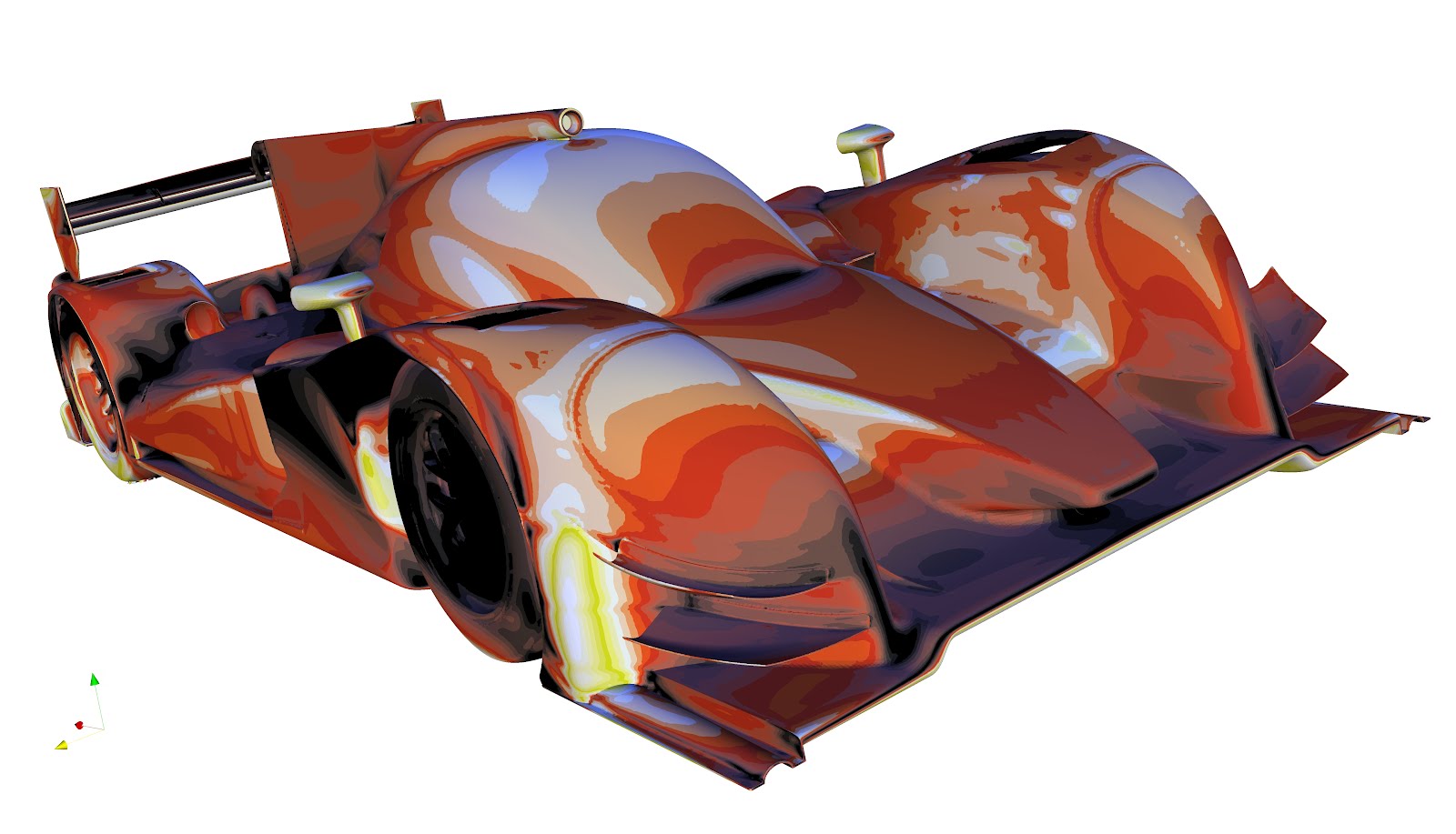
I am also introduced to Phil Tiller, CFD Manager, who takes me through the processes used in the design phase at Lola, where Computational Fluid Dynamics and Finite Element Analysis is used without the need for the expense of wind tunnel time. “Of course we still need the wind tunnel, to validate the findings here,” says Phil, “but the speed with which we can do design and development before it goes to the wind tunnel, means that we get to the optimum design much more quickly.”

CFD is not just used for bodywork and aero design - Tiller also shows me the dynamics of the refuelling process. “We take the viscosity of the fuel and the shape of the tank into account, and work out how we can get the fuel into the tank as quickly as possible within the constraints of the gravity feed demanded by the regulations.”

A large part of the work at Lola, is however, nothing to do with racing cars. And if racing car design is a sensitive matter, there is a whole department that I am not even allowed to visit - which sees Lola doing work on Unmanned Aerial Vehicles (UAVs) for the Ministry of Defence. The Mantis was designed and built for BAE systems in just three months, and Lola also produces and assembles the Watchkeeper range.

In some ways, this work is more crucial to the company than the racing. “If we can base the financial security of the company on the defence work, then that enables the racing development to continue,” says Smith. “The trouble with motor-racing is that is ebbs and flows, and that makes it difficult to rely upon any revenue streams. The government isn’t like that.”

The Managing Director of Lola Cars International is Jean Marchioni, who joined from Level 5 Motorsports in the USA in March this year. The tone for our meeting is set as Sam and I are admiring a photo on the wall of the boardroom showing two Lola Mk4s in the pit lane at Monaco in 1962. “That was the first race I went to,” says Marchioni, as he comes in. “You can see here behind, the castle is here, and there is a road with a wall, you know - that is where we watched from. We didn’t have grandstand tickets or anything, we just sat on the wall, overlooking the gasworks hairpin.”

Much of the rest of our conversation revolved around the state of sportscar racing and the squabbles between the various organising bodies. It can be read on dailysportscar (if you are a subscriber), but some fascinating other snippets that weren’t really relevant to that article also came up.

Such as when we were talking about Jean Alesi (exactly how the conversation got onto that subject I can’t quite remember), and Marchioni said “I know Jean very well, I ran him in karting. Actually I am trying to get hold of him right now to see if he needs a spotter at Indianapolis. It would be cool to re-unite and for me to go to Indy.” There speaks a real enthusiast, not just the MD of a successful manufacturing company.

And on Don Panoz: “He’s a really interesting guy - I had a few conversations with him. I think the guy is awesome. He is always thinking about going global. He is not thinking about doing something in his own little corner to protect what he has. He has a wide range of thinking. Look at his businesses - they are all over the world. When he wakes up every morning he knows that five million or six million dollars went in the bank!”

The other topic that kept creeping into the conversation was that of a Lola “works team”. Sam Smith makes it clear: “Martin Birraine, our CEO, doesn’t want it to happen. It isn’t really feasible anyway, as we exist for our customers. Sure it can be frustrating not being able to choose our drivers, and always having to think about the financial side. The heartbeat of the team is the racing… if you would ask the workforce, I am sure they would want a works team.”

What is clear though is that if a major manufacturer would come to Lola with a partnership proposal, then a quasi-works project similar to the Nissan Le Mans effort in 1989/90 would “absolutely be possible,” in Marchioni’s words. “It would be the only way we would do it. It would need to be in the building next door (or somewhere). We need to keep the customers comfortable with what we are doing, as the business side is still very important to us. But we are constantly talking to manufacturers, looking for opportunities. You have to remember that from concept to finished product, we can do it really quickly here - and we have a lot of brainpower upstairs.”

Wednesday, 2 May 2012

Dailysportscar

Readers of DailySportsCar.com will have noticed, if they are paying attention, that I have been appointed as Features Editor. This is something that Graham Goodwin - the editor of dailysportscar - and I have been discussing for some time, but only now has it come to pass that it can be made official.

The idea is, that with an increasing amount of content on dailysportscar being free now, there is something for the subscribers that will cause them to renew their subscriptions, when they become due, and moreover, that the increasing number of viewers of the free material will be tempted into subscribing when they see a little of what they are missing. As a business case, it does make sense. The annual subscription, at just £35, is not extortionate, and if enough 'free' viewers are prepared to subscribe, then the coffers will fill sufficiently to pay for the roster of writers that will make up the "features team".

So if it doesn't work, then the subscription only features will have to stop - simple as that. Not that I do this for the money - indeed there is no money at all to be made out of blogging - but I do prefer to 'formalise' such things... so that readers know what they are going to get. If all the plans come off, then dsc subscribers will be seeing a 'feature' every few days - an average of two a week.

As Graham said to me recently, "more 'Motor Sport' than 'Autosport' ". We'll see how it goes. One concern that I do have is that the time taken to look after my new responsibility will have to come at the expense of something. And one of those things might be this blog.

I don't want to steal Graham's thunder by revealing here the full roster of writers, but it is a funny feeling to be put in a position to "edit" the writing of folk that I've read for years and who have been making a living from writing, while I have been 'doing a proper job'.

I just hope that we (Graham, the writers, and me together) can make it work, and maintain a level of consistent quality that is too easy to lose once initial enthusiasm for the new project has worn off. Meantime, the season progresses: Spa this weekend, then the Nürburgring, then it's Le Mans. That should provide sufficient inspiration for us all to find something to write!

Friday, 27 April 2012

Audi Racers and Writers

I was delighted, recently, to receive an invitation from Audi to their "Racers and Writers" dinner, held at Goodwood House earlier this week. Although I have been to the Goodwood Revival race meeting in the past, I had never set foot in the house - and a very splendid place it is too

The "Racers" element of the guest list read like a who's who of folk who have raced Audi cars over the years, including Tom Kristensen, Allan McNish, Oliver Jarvis, James Weaver, Andy Wallace and Richard Attwood. Then there were rally drivers Stig Blomqvist and Harald Demuth. From the engineering side were Howden 'H' Haynes, Leena Gade and Kyle Wilson-Clarke. Finally, masterminds of organisation Dr Wolfgang Ullrich and John Wickham were also present, but both refrained from providing any management input!

The evening was organised in great style by Audi, yet was an informal affair. We were offered a brief tour of the house - which was fascinating. Although I am not a student of fine art, it was impossible not to be impressed by paintings from Canaletto and Stubbs, by 18th century tapestries from Louis XV and by the superbly well-preserved ambience of a 300-year old stately home filled with period furniture.

Lord March was also present and gave a welcoming talk, dinner was superb (salmon followed by sirloin steak) and a great time was had by all. I have to admit that I spent most of time enjoying myself, rather than trying to pick any great secrets out of anyone - it was super just to be able to talk about cars and racing until the small hours of the morning.

I was surprised, though, to learn that at Le Mans this year the Allan McNish Audi e-tron quattro will not be engineered by Howden Haynes. This will be something of a departure, since H has worked on the car of McNish, Kristensen and Capello for the last five years. This year, though he will be working on the R18 ultra of Oliver Jarvis, Mike Rockenfeller and Marco Bonanomi. The full list of assignments goes like this both for Le Mans and for Spa:

Number Car Drivers Engineer
1R18 e-tron quattroFässler/Lotterer/TréluyerLeena Gade
2R18 e-tron quattroMcNish/Kristensen/CapelloDominic Zeidtler
3R18 ultraDuval/Bernhard/DumasKyle Wilson-Clarke
4R18 ultraJarvis/Rockenfeller/BonanomiHowden Haynes

There doesn't seem to be anything particularly sinister or conspiratorial here - it is merely that H found himself working more on the ultra over the winter, whereas Zeidtler (an experienced race engineer from Joest) has spent more time with the hybrid. It does, however, raise an interesting question for the race in June. Since the Le Mans 24 hours is a round in the WEC, a tactical, (double) points-scoring finish might be attractive to those with World Championship aspirations. For H and his team of 'young chargers', points will not mean a thing. For H, Le Mans is and should be 'win or bust'!

As for news about Timo Bernhard's recovery, following his testing accident at Sebring, I was unable to discover anything. However, it struck me as significant that the nominated reserve driver, Marc Gené, will join Dumas and Duval at Spa. But Jarvis and Bonanomi will race at Spa as a two-driver team, as Mike Rockenfeller is occupied with the DTM at Lausitzring. Interestingly, in conversation with Haynes and Jarvis, H said that he saw it as a good thing... one less driver meant one less thing to worry about. And over six hours, the strain on the driver is not nearly so great as at Le Mans. Obviously, Jarvis and Bonanomi will benefit from the extra seat time, neither having raced an Audi prototype before. But there would be no point in putting Gené in the car at Spa unless there was at least a small chance that he would be racing at Le Mans as well, is there?

One other highlight of the evening is worth a mention: the presence of the Le Mans-winning Audi R18 TDI outside the house - I had known that it hadn't been cleaned since its victory; and there it was, shipped over from Ingolstadt especially for the occasion and still looking very scruffy. One day it will have to be scrubbed up, but not just yet.

Tuesday, 17 April 2012

Graham Tyler

Graham and I have known each other for a long time. I became aware of him at Le Mans in 1990, when he first worked officially as a ‘spotter’ for Radio Le Mans. He would go off into the countryside to sit beside the track with a walkie-talkie radio and send in messages about cars with problems, or in qualifying he would spot which cars were about to set a fast time. He’d first gone to Le Mans in 1980 (the year before me) and inevitably, been bitten by the bug. When Radio Le Mans arrived in 1987, Graham would make a point of listening, and periodically would pop into the studio caravan with a piece of paper with various notes that he’d made - many of which would answer questions that had been posed on the radio - in those days without wall-to-wall TV coverage, no in-car cameras and little in the way of media information, piecing together what was happening on a minute-by-minute basis was far from simple.

As a result of that contact, I asked him to assist me doing lap charts when I was doing circuit commentaries, not just for endurance races, but also for plenty of other meetings - including the British Grand Prix - not only Silverstone, but also at Brands Hatch, Donington and elsewhere. At lap charts, as with almost everything that he undertook, he was thorough and meticulous - not to mention jolly good company.

Over time, Graham and I became good friends. He had his priorities well-sorted, and having spent so long in the background of Radio Le Mans, I was pleased when he stepped forward to become one of Radio Le Mans pit lane commentators in 2002. Memorably, his first interview on raceday was with Jacky Ickx and any nerves - on either side - were not apparent; Graham’s naturally engaging character was well-suited for talking with drivers and other personalities. His style is easy-going, but he never shies away from ‘the big interview’ and is invariably in the thick of the media scrum that surrounds the winners at the end of the race.

There are times though, when he surprises me. Graham thinks carefully about what he does, but that doesn’t stop him from taking what may sometimes seem to be spontaneous decisions when his dreams beckon. I didn’t expect him to embrace the opportunities for travel that first the ALMS, then the FIA GT series offered him. Indeed, I will admit to some twinges of jealousy as I focussed on my own life and my new family while Graham was travelling to races in far-off and exotic places.

In addition to the ALMS, he covered the FIA GT series for TV, forming a popular double act with Richard Nichols between 2005 and 2008.

And he surprised me again last week, with an email announcing that he would not be part of the Radio Le Mans team for 2012. “It hasn’t been an easy decision,” he wrote, “but I truly do feel it’s the right one.” So when I rang him and asked him what I could do to make him change his mind, I already knew what his answer would be.

“If I can’t give of my best, then I’d sooner open the door to someone new who can.” Well, the purpose of this article is not to open a discussion about who that should be, but rather to give a little respect to someone who has done an outstanding job for Radio Le Mans in the past twenty years.

I’ve tried to get to the bottom of Graham’s decision - and it is not any one thing in particular. Partly, it is because Le Mans is not what it once was, neither the race nor the place. The changes to the track and its surroundings have undoubtedly been necessary, but they have changed the character of the place. Safety regulations being what they are, there is a tendency for circuits to become more and more homogenised. In Graham’s own words: “I reached the point where Le Mans didn’t feel magical any more, […] that’s what Le Mans should be - magic.”

Graham hasn’t quite embraced the new breed of prototype, either. “The diesels, though fantastically efficient, are about as exciting to listen to as my little Vauxhall Corsa, and that hideous dorsal fin now proscribed for all of them on safety grounds, simply destroys what would otherwise be a deliciously swooping profile on almost any chassis you care to name. In short, somehow they just don’t stir my soul, which racing cars really should,” he says.

In some ways, I can understand his decision, although for my own part I am not about to make a similar one. I’m hoping that he will take a year or two away, find that he misses it all dreadfully, and then makes a return. It would seem that for 2012 at least, his approach, insight and understanding will not be a part of the Radio Le Mans broadcast - which is a shame, don’t you agree?

Thursday, 12 April 2012

Lap Charts

Following my post about getting started in commentary, inevitably, someone asked about lap charts. In the old days, the raceday programme that you bought when you were at the track always contained a blank lap chart template, and it was this that got me started in the first place. The image below is from a Thruxton programme in 1977 - unfortunately the BARC lap charts only allowed you to record the cars in the top six positions though.


There is a book called "How to Watch Motor Racing" by Stirling Moss, (it's available second hand from Amazon) and although it is terribly out of date now, it is a jolly good read. In it are (amongst other things) instructions about how to keep a lap chart. In essence, all you do is to write down the numbers of the cars each time they pass you. Write them down in a column, starting a new column each time the leader comes past. Here is a photograph from the relevant page in Stirling's book - you can see how number 7, having led the race until just after half-distance, drops out, and number 17, starting from the back, comes through to finish on the podium.

This is what I call a "block chart" - it is a term I learnt from Mike Eyre, a chief RAC timekeeper in the 1980's. It is also sometimes these days called a "position chart", in that it gives you the position of each car on each lap. If you look on the TSL Timing website, they provide an electronic version of this after most major events in the UK where they are officiating.

This chart is very useful, and relatively easy to produce for short races. It helps if you can write quickly, legibly, and in a straight column, without having to look down at what you're writing.

Note though, that when the leader starts to lap the backmarkers, you have to record the backmarker in a previous column - he has not, after all, completed the same number of laps as the race leader. This is where it gets difficult with a long-distance race: the leaders will lap slower cars many times and even the mid-field runners will lap those at the back. Here is my block lapchart for the 1000km race at Brands Hatch in 1986.

This is just the first 50 or so laps of a 236 lap race - so there is a lot of paper to the right of the photograph!

Things to note (you might have to expand the photo):
  • horizontal (green) lines dividing the positions after every five cars... this is useful to quickly be able to see who is running in, say, 12th place.


  • vertical (green) lines - these show the start and end of safety car periods. As the race goes on you can observe how these lines spread across several laps, showing how the field gets spread out as the backmarkers lose more and more laps to the race leaders.


  • circle around cars when they make a pit stop - apart from anything else, this also makes it easier to find when it rejoins, probably losing places as a result.


  • The trouble with trying to keep a block chart going is that you will often get three cars crossing the line close together, all on different laps, and by the time you have found where they all belong on the chart, another two cars will come past and you easily get lost.

    The answer is to have an assistant, doing a "running chart". This merely records the number of each car as it comes past, in the order that the cars are running on the track. Don't worry about which cars are a lap behind, just make sure that you record each car. Start a new column every time the leader comes past, just because it is a good check on how many laps are completed. In the early stages, of course, before the lappery starts, it will closely resemble the block chart, but as the race develops, it provides the raw data input required to facilitate the block chart. Indeed, the first time I enlisted a helper to do this, I ended up spending more time looking at the running chart than I did looking at the cars on the track.

    If you looked up TSL's website before (to look at a position chart) - look now for what they call a "Lap Chart", and look at the column containing the car number. This gives the order that the cars cut the timing beam, and effectively shows what the running chart looks like. Of course some columns are longer than others, depending who rejoins from pit stops, or whether the leader has stopped.

    So to summarise (for the benefit of Chris, who asked the question) a block chart shows you at a glance the position of each car, and how many laps they have all completed; whereas the running chart just shows the order that cars are running on the track.

    If you're quick, and have a stop watch, you can make notes on the running chart of the gaps between significant cars - this way you'll pick up who might be closing on whom, and whether a pass for position might be on the cards. Even with electronic timing, I still find a lap chart massively helpful, not only in following a race as it unfolds, but also to keep as a record of what happened.

    Wednesday, 4 April 2012

    BTCC at Brands Hatch

    I had a marvellous day out at Brands Hatch on Sunday, watching the British Touring Car Championship with my 11-year old son. We went as proper paying spectators, thanks to the generosity of Peter Nally at Nally-Track & Corporate, who cut us a very reasonable deal on the hospitality and great views of the Indy circuit offered by his suite in the Brabham Centre, overlooking the straight of the same name.

    There was a big crowd there, and we witnessed a pretty packed day of racing entertainment - Ginettas, Porsches and Renault Clios interspersing the three races for touring cars. Having arrived at 9:00am, I was expecting my son to get bored long before the end of the last race, but thanks to the comfort of the suite, the entertaining company and the thrills and spills of racing, we stuck it out until well past 6 o’clock before heading home (via an inevitable souvenir purchase at Alex Reade).

    Although I am still as passionate as ever about endurance racing, the day was a good example of how to bring spectators through the gate and entertain them - not with off-track attractions like bouncy castles, Top Gear simulators and over-priced merchandising (all of which were at Brands and doing a roaring trade) - but with good, solid, proper motor racing.

    Collard leads race 1
    Get folk in with the ‘soap opera’ names like Plato and Neal; with cars that the public can relate to; keep the action rolling along, and they will learn how to watch a sprint race: it’s a formula that worked for me before I hit my teenage years, and it will encourage others nowadays. You don’t learn to read by starting off with Dickens, Shakespeare or Tolstoy. But the seeds of leisure reading are planted by making reading entertaining, and inspiring you to read more challenging stuff as you get older. If the thought of attending six, twelve or twenty-four hour races is too much for you, go and see the BTCC, and see what it leads to.

    One thing that I was very aware of at Brands was that despite the presence of a TV screen in the suite, nobody was watching it - the view out of the window at the real thing kept people spellbound. Long may it be thus - watching racing on a screen just isn’t the same. You have to be there to get the full experience.

    Plato on the way to victory in race 3

    Live motor sport - unbeatable!