Tuesday, 28 August 2012

Why Audi won at Silverstone

The gap between the winning Audi R18 e-tron quattro and the second placed Toyota TS030 at the Silverstone Six hours was just over 55 seconds at the chequered flag. Both the Audi and Toyota had faultless runs during the six hour race - only a stop/go penalty for the Audi meant that it lost 27 or 28 seconds on that lap.

The following tables are hopefully self-explanatory, if not please let me know.

First for Audi number 1 of André Lotterer, Benoît Tréluyer and Marcel Fässler, which had eight driving stints separated by seven pitstops.

Stint Driver From time To time Laps Notes
1 Lotterer 12:00:00 12:46:21 26 Plus lap to grid and FL
2 Lotterer 12:47:15 13:35:34 27
3 Tréluyer 13:36:53 14:32:07 29 Incl 3 behind SC
4 Tréluyer 14:33:01 15:10:35 21
5 Tréluyer 15:11:11 15:23:43 7
6 Fässler 15:25:00 16:15:02 28
7 Fässler 16:15:56 17:11:01 29 Incl 3 behind SC
8 Lotterer 17:12:18 18:00:39 27 To finish

Note stints four and five, which should really be counted as a single stint, since the pitstop which separated them was the stop/go penalty.

Now here are the details for each pit stop:

Pit Stop Activity Time in pit lane Fuel added
1 Fuel only 54.3s 56.20 litres
2 Fuel and tyres, driver change 1m 18.3s 56.10 litres
3 Fuel only 54.6s 56.09 litres
4 Stop & Go 35.3s
5 Fuel and tyres, driver change 1m 17.1s 56.65 litres
6 Fuel only 54.0s 57.03 litres
7 Fuel and tyres, driver change 1m 17.5s 55.88 litres

For the number 7 Toyota, driven by Alexander Wurz, Kazuki Nakajima and Nicolas Lapierre, here are the same tables. Compare them yourself.

Stint Driver From time To time Laps Notes
1 Wurz 12:00:00 12:39:01 22 Plus lap to grid and FL
2 Wurz 12:40:01 13:20:51 23
3 Nakajima 13:22:19 14:10:36 25 Incl 3 behind SC
4 Nakajima 14:11:37 14:54:18 24
5 Lapierre 14:55:44 15:36:51 23
6 Lapierre 15:37:51 16:18:51 23
7 Wurz 16:20:16 17:04:34 23 Incl 3 behind SC
8 Wurz 17:05:32 17:32:17 15
9 Wurz 17:33:02 18:01:35 16 To finish


Pit Stop Activity Time in pit lane Fuel added
1 Fuel only 59.7s 68.68 litres
2 Fuel and tyres, driver change 1m 27.6s 68.74 litres
3 Fuel only 1m 00.6s 70.12 litres
4 Fuel and tyres, driver change 1m 25.7s 69.84 litres
5 Fuel only 59.6s 66.81 litres
6 Fuel and tyres, driver change 1m 24.2s 65.77 litres
7 Fuel only 58.1s 63.96 litres
8 Fuel only 44.8s 32.45 litres

I'm not going to offer any further comment (here), but the Toyota's faster average lap time and the Audi's faster (and fewer) pitstops provided a tremendous race at Silverstone and promises much for Brazil, Bahrain, Japan and China.

Thursday, 9 August 2012

Getting the juices flowing

I have been a busy boy with all manner of things in recent weeks, both related to racing, and nothing to do with it. As a result, I have found little time (and, I’ll confess, little motivation) for writing on this blog.

Consequently, I feel certain twinges of disappointment about this, as I enjoy reading people’s comments, and enjoy seeing, among other things, the geographical spread of my readership.

The trouble is, that many of the areas that I feel worthy of comment are areas that you, dear reader, can read elsewhere on the internet or on the printed page. Why should you be interested in the things that I either agree or disagree with? Why should you come to this blog to read what you can perfectly well read elsewhere? What I would like to offer you, as members of a pretty exclusive group of folk who read this, is something unique; something that you cannot read elsewhere: something that is, to coin a phrase, trussers-esque.

One thing I love to do is to look back and compare the past to the present day. Sometimes this gives a great insight into the inevitability of events that unfold; other times you get completely surprised by what happens. Economists in the world of financial affairs always seem to be falling into the trap of suggesting that things will turn out the way they did the last time things were like this and yet, somehow things don’t quite fall out as expected.

In the world of motor racing, I was surprised recently on re-reading Stirling Moss’s account of the 1959 Le Mans 24 hour race at what a big topic the subject of slower drivers was: Moss’s dislike of the race is well-known, but here’s part of what he has to say on the matter:

“I think the whole race is far too dangerous, simply because of the slow cars involved, plus the inexperienced drivers. And I think the latter are by far the greatest problem of all.” He goes on to say: “This matter of inexperience in driving doesn’t really involve the total amount of racing a man has done. What counts is the amount he has learned while he has been doing it. That and his general level of ability and intelligence. A man can race every week-end for years and still come in the category of ‘inexperienced’. We have several of them around now who have put in a tremendous number of hours on circuits all over the place, and they still can’t drive a nail. It’s difficult to know what can be done about it. Really, in races like Le Mans, drivers who haven’t had so much experience in terms of numbers of races, but who have learned quickly, should have preference over those who could race till kingdom come and never learn.”

In the book, Moss also asks the winning drivers Roy Salvadori and Carroll Shelby for their views, after the race is over. This is Salvadori: “I had difficulties passing other cars lots of times this year. Mostly with the small French cars. They won’t look in their mirrors and they won’t move over. I’m afraid they just haven’t the same consideration for the faster cars that most of our British drivers have.

“I don’t think the inexperienced drivers are necessarily the most blameworthy. In fact, I noticed that some of the worst baulking was done by very experienced drivers in some of the Panhards. I think some of it was absolutely intentional. No doubt about it. They saw you in their mirrors and still baulked you.”

And Shelby: “The inexperienced drivers in small cars seem to get in your way more. Inexperienced drivers in large cars seem to try to stay out of your way. The first-timers in the little cars give you more trouble for some reason.”

Moss then presents an inspired idea: “What to do about the problem I really don’t know. But one solution does occur to me. If Le Mans was a double-twelve-hour race instead of a single twenty-four, you could drive the thing single-handed. That would halve the driver difficulties immediately. Instead of having two dozen top drivers for the twelve top cars, you would only need one dozen, so there would be a reasonable number of experienced men to distribute amongst the other entries.”

Such lovely fifties’ prose - who says that our language doesn’t evolve? Even if rules of grammar are maintained, style develops - no-one writes like that in 2012. But aside from the style of the matter, I wonder if Moss would be surprised that, more than fifty years later, the same problem exists with slower cars today. In fact you could argue that the problem is worse, since we now have three drivers per car, increasing still further the number of drivers required. Today, drivers take more care in ‘not saying the wrong thing’, but essentially, to my mind, it has nothing to do with sponsorship, regulations or even nationality. It is part of the race, part of racing itself, and as one LMP1 driver said to me recently, it is actually part of the attraction, to be overtaking so many cars per lap.

After this year’s race, I did some analysis and estimate that the winning car made more than 1,500 overtaking moves over the duration of the race. That’s cars actually overtaken on the track - not cars stopped in the pits. I then extended this analysis to each car, and reached a total of more than 10,000 overtaking moves in the race altogether. It’s inevitable that some of these will have been easier than others, but the trick must surely be to ensure that each of one is completed safely and successfully.

And if that’s not “Trussers-esque”, then please tell me what is!

Monday, 9 July 2012

Audi hybrids

Just about everyone reading this will, I suspect, know that the Le Mans 24 hour race was won this year by an Audi R18 e-tron quattro. And back in May, the 6-hour race at Spa-Francorchamps was won by an Audi R18 ultra. The difference between this two cars? The ultra is driven by a (relatively) conventional 3.7 litre V6 turbo-charged diesel engine and the e-tron quattro has the power of the engine supplemented by an electric motor, which is charged by a flywheel, spun up to speed when the car is braking. Now that's about as far as my technical knowledge goes, but I am aware of how Audi's technical endeavours on the race-track are quickly reflected by their offering in the road car market. And as an Audi customer, I find it interesting that, I can buy a TDI-engined Audi featuring "ultra lightweight technology", from my local Audi dealer, but I cannot get a hybrid Audi, despite the win at Le Mans, and unlike rival Toyota. So what's going on? Happily, David Ingram, PR Manager for Product and Technology at Audi UK has filled me in with the details, which I share for no other reason really than that it is interesting... Audi's "first generation" road car hybrid technology is currently available on the Q5 (but not in the UK). Later this year, a hybrid A6 will be available, and next year (probably) UK customers will be able to buy a hybrid A8. The conventional power source on these cars will in all cases be the four cylinder, two litre TFSI (petrol) engine. This will be supplemented by an electric motor that will be charged under deceleration, providing sufficient energy to power the car on purely electric power for a maximum of around 3km. Despite having "hybrid" powertrains, these cars will not be given the "e-tron" branding, as this will be reserved for Audi's next generation of hybrid, which will probably not be released until 2014. These will have a larger capacity battery, which will be capable of being plugged into the mains to charge - as well as being charged on deceleration, as in the first generation car. Visitors to Goodwood's Festival of Speed might have seen a concept of the A3 e-tron on display in the Audi pavilion. This has an electric-only range of about 50km. Audi's principle is that the e-tron badge will be given to any car that can be plugged into mains electricity to charge the battery pack. The first e-tron road car to be introduced is the A8 e-tron, (before the end of this year, I am told) - and this will be pure electric, not a hybrid. Whilst I do not for a moment doubt Audi's commitment to improving road car technology through its racing, and the importance of aligning the racing and road car activities, I do sense slightly that there was a case, this year, of the hybrid racer being introduced purely to take advantage of regulations, rather than necessarily to promote Audi hybrid drivetrain in its production car range. The Le Mans 24 hours is more important than a marketing exercise.

Sunday, 1 July 2012

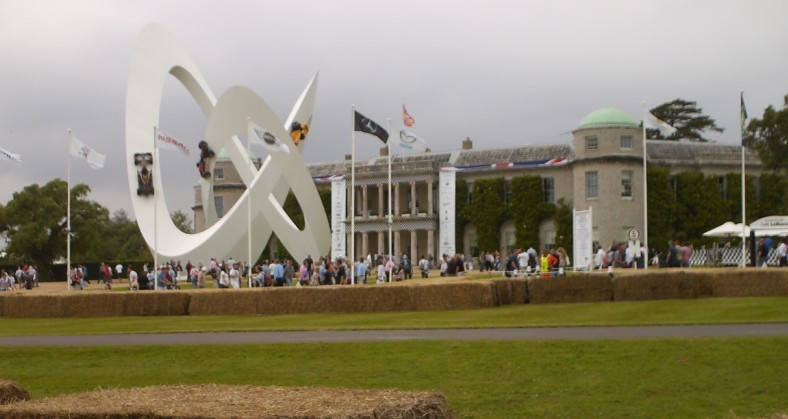
Goodwood's Moving Motor Show

It was Roy Salvadori that was quoted as saying "Give me Goodwood on a summer's day and you can keep the rest". I had the opportunity to visit the Earl of March's estate again on Thursday, in the run-up to the weekend's Festival of Speed, and I can see what he meant. The park's setting in the Sussex Downs is indeed idyllic, and the weather, while not perfect, was still lovely, if a tad blustery. I have to say though that the organisation of getting (admittedly very many) spectators into and out of the place left something to be desired.

Signposts to the event clearly stated which way did not provide access, and showed the way that taxis were to go, but I found it extremely difficult to get myself in the way that the organisers (SEP events) wanted me to go. Even in Chichester, signposting was minimal; maybe more signs were being prepared for the weekend itself, but I found it quite unsatisfactory. Once parked, there was a fifteen minute wait for a tractor ride, which saved us a ten minute walk across the car park - and then no indication at all of where to go next - unless one knew that through the Aviation Exhibition lay the main entrance.

Once inside, though, Charlie March's organisation and attention to detail took over and everything ran far more smoothly. I have never attended the Festival of Speed - it had never really appealed to me, but complimentary tickets to the "Moving Motor Show" had been given to me by my local garage, and so I took the opportunity.


All of the exhibition space was open, as were the paddocks - and a great deal of effort was clearly being spent by many leading manufacturers to promote their brands.

Away from the corporate hospitality though, there were treats aplenty, with motor sporting vehicles on display representing more than 100 years of history. The most modern example was of the Audi R18 e-tron quattro - not the same chassis as the one which won Le Mans last month, but nevertheless a celebration of the 11th win by Audi in the 24 hours.


Elsewhere in the "Formula 1" paddock was the Eagle-Gurney Weslake (the same chassis that won at Spa in 1967? Possibly, I don't know), a Toyota TS030 Hybrid and Lotus cars in abundance.

The spooky thing I found here were so many cars that I remember seeing at race meetings, and yet for many, these are historic racers. It's not even the case that I'm particularly old!

In the "Cathedral Paddock" (conveniently not shown in the event programme that I paid £5 for) were a tremendous collection of Group C cars and other sports racers. These were joined by various iconic touring cars, among them a Nicola Larini Alfa 155 DTM car, a Klaus Ludwig Zakspeed Capri, and at least four Gerry Marshall Vauxhalls.

Various Le Mans winners were on display, although I have to admit I may have been taken in by a replica here or there. Porsche 956 and 962C were there, as were Jaguars from 1987, 1988 and 1990.


Lovely, very lovely.

Friday, 29 June 2012

More on Average Lap Time comparisons

It is no secret that I am a big fan of average lap times... particularly when analysing driver performances.

Last year, at the Le Mans Test Day, the fastest stint (of 11 laps) was done by Dindo Capello at 3m 33.1s. In the race, Benoît Tréluyer completed 10 laps in 3m 28.8s. This average is worked out from pit out at the start of the stint, until pit in at the end - thus including the out an the in lap, but excluding the time spent driving up the pit lane.

This year, the fastest stint on the Test Day was by André Lotterer, who did 3m 31.5s for 12 laps. In the race, this improved to 3m 27.1s - over 12 laps by Allan McNish. Remember that the cars this year had less fuel available and less power.

I was interested to compare this with Toyota, but of course by the Sunday morning 'happy hour', when McNish was in his 'purple patch', both Japanese cars had retired. Looking at the best average lap time for an 11/12 lap stint up to 8pm Saturday evening though, gives the following:

Position Number Car Driver Time No. of laps
1 7 Toyota TS030 Hybrid Lapierre 3m 29.8s 11
2 1 Audi R18 e-tron quattro Lotterer 3m 30.1s 12
3 2 Audi R18 e-tron quattro McNish 3m 30.4s 12
4 3 Audi R18 ultra Dumas 3m 30.5s 12
5 8 Toyota TS030 Hybrid Buemi 3m 30.8s 11
6 4 Audi R18 ultra Bonanomi 3m 31.0s 12


I think the remaining races in this year's WEC could be quite close. Silverstone is next, on 26th August. With the chance of some family time on Bank Holiday Monday!

Monday, 25 June 2012

Audi Driver rotations at Le Mans

It was interesting to see at Le Mans this year, both the Audi R18 e-tron quattros, which finished first and second in the 24 hour race, juggling their driver sequence.

It was unusual last year that Marcel Fässler was excluded from the driver rotation by a team decision. However, this year, both the number 1 Fässler / Tréluyer / Lotterer and the number 2 McNish / Kristensen / Capello cars changed the rotation through the race.

The driver sequences were:
Number 1:
- Lotterer (3 stints)
- Tréluyer (4 stints plus 3 laps)
- Fässler (3 stints)
- Lotterer (3 stints)
- Tréluyer (2 stints)
- Fässler (3 stints)
- Lotterer (5 stints)
- Fässler (4 stints)
- Tréluyer (3 stints)
- Lotterer (3 stints)

In total, Lotterer completed 156 laps, driving time 9h 26m 23s; Tréluyer completed 111 laps (6h 53m 24s) and Fässler 111 laps (7h 00m 31s).

Number 2:
- McNish (3 stints)
- Kristensen (4 stints)
- Capello (3 stints)
- McNish (3 stints)
- Kristensen (3 stints)
- McNish (3 stints)
- Capello (3 stints)
- Kristensen (3 stints)
- Capello (2 stints)
- McNish (4 stints) - including crash at Porsche curves
- Kristensen (2 stints)

The total driving times were: McNish - 148 laps, 9h 10m 58s; Kristensen - 136 laps, 7h 59m 14s and Capello - 93 laps, 6h 05m 05s.

In the number 1, Benoît Tréluyer was suffering from a bad cold, apparently caught when he was out in the rain on Friday night, which neatly explains the reason why he was given a slightly longer rest overnight.

In the number 2 car though, I wonder whether Dindo was given the 'happy hour' to let him celebrate his birthday in style, in what will probably be his last Le Mans? If they hadn't changed it, perhaps McNish would not have been the one in the car when it came across the slower car in the Porsche curves... and maybe, just maybe, the result might have been different.

Wednesday, 6 June 2012

Audi - Longer, faster and on less fuel

We are currently on a family vacation, enjoying the sunshine of a Mediterranean villa.

However, looking at the times from the Le Mans test day, it looks to me that the Audi R18 e-tron ultra can go further on less fuel than last year's Audi R18. What's more, it is doing faster average lap times as well. I reckon it was managing 12 laps on a tankful!

A full analysis will appear later in the week on dailysportscar.com - provided I can (a) get a decent Internet connection and (b) manage to drag myself away from the pool!