Sunday, 1 July 2012

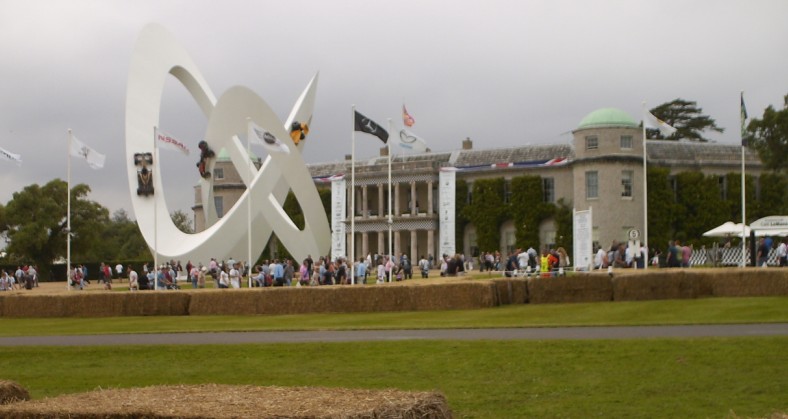
Goodwood's Moving Motor Show

It was Roy Salvadori that was quoted as saying "Give me Goodwood on a summer's day and you can keep the rest". I had the opportunity to visit the Earl of March's estate again on Thursday, in the run-up to the weekend's Festival of Speed, and I can see what he meant. The park's setting in the Sussex Downs is indeed idyllic, and the weather, while not perfect, was still lovely, if a tad blustery. I have to say though that the organisation of getting (admittedly very many) spectators into and out of the place left something to be desired.

Signposts to the event clearly stated which way did not provide access, and showed the way that taxis were to go, but I found it extremely difficult to get myself in the way that the organisers (SEP events) wanted me to go. Even in Chichester, signposting was minimal; maybe more signs were being prepared for the weekend itself, but I found it quite unsatisfactory. Once parked, there was a fifteen minute wait for a tractor ride, which saved us a ten minute walk across the car park - and then no indication at all of where to go next - unless one knew that through the Aviation Exhibition lay the main entrance.

Once inside, though, Charlie March's organisation and attention to detail took over and everything ran far more smoothly. I have never attended the Festival of Speed - it had never really appealed to me, but complimentary tickets to the "Moving Motor Show" had been given to me by my local garage, and so I took the opportunity.


All of the exhibition space was open, as were the paddocks - and a great deal of effort was clearly being spent by many leading manufacturers to promote their brands.

Away from the corporate hospitality though, there were treats aplenty, with motor sporting vehicles on display representing more than 100 years of history. The most modern example was of the Audi R18 e-tron quattro - not the same chassis as the one which won Le Mans last month, but nevertheless a celebration of the 11th win by Audi in the 24 hours.


Elsewhere in the "Formula 1" paddock was the Eagle-Gurney Weslake (the same chassis that won at Spa in 1967? Possibly, I don't know), a Toyota TS030 Hybrid and Lotus cars in abundance.

The spooky thing I found here were so many cars that I remember seeing at race meetings, and yet for many, these are historic racers. It's not even the case that I'm particularly old!

In the "Cathedral Paddock" (conveniently not shown in the event programme that I paid £5 for) were a tremendous collection of Group C cars and other sports racers. These were joined by various iconic touring cars, among them a Nicola Larini Alfa 155 DTM car, a Klaus Ludwig Zakspeed Capri, and at least four Gerry Marshall Vauxhalls.

Various Le Mans winners were on display, although I have to admit I may have been taken in by a replica here or there. Porsche 956 and 962C were there, as were Jaguars from 1987, 1988 and 1990.


Lovely, very lovely.

Friday, 29 June 2012

More on Average Lap Time comparisons

It is no secret that I am a big fan of average lap times... particularly when analysing driver performances.

Last year, at the Le Mans Test Day, the fastest stint (of 11 laps) was done by Dindo Capello at 3m 33.1s. In the race, Benoît Tréluyer completed 10 laps in 3m 28.8s. This average is worked out from pit out at the start of the stint, until pit in at the end - thus including the out an the in lap, but excluding the time spent driving up the pit lane.

This year, the fastest stint on the Test Day was by André Lotterer, who did 3m 31.5s for 12 laps. In the race, this improved to 3m 27.1s - over 12 laps by Allan McNish. Remember that the cars this year had less fuel available and less power.

I was interested to compare this with Toyota, but of course by the Sunday morning 'happy hour', when McNish was in his 'purple patch', both Japanese cars had retired. Looking at the best average lap time for an 11/12 lap stint up to 8pm Saturday evening though, gives the following:

Position Number Car Driver Time No. of laps
1 7 Toyota TS030 Hybrid Lapierre 3m 29.8s 11
2 1 Audi R18 e-tron quattro Lotterer 3m 30.1s 12
3 2 Audi R18 e-tron quattro McNish 3m 30.4s 12
4 3 Audi R18 ultra Dumas 3m 30.5s 12
5 8 Toyota TS030 Hybrid Buemi 3m 30.8s 11
6 4 Audi R18 ultra Bonanomi 3m 31.0s 12


I think the remaining races in this year's WEC could be quite close. Silverstone is next, on 26th August. With the chance of some family time on Bank Holiday Monday!

Monday, 25 June 2012

Audi Driver rotations at Le Mans

It was interesting to see at Le Mans this year, both the Audi R18 e-tron quattros, which finished first and second in the 24 hour race, juggling their driver sequence.

It was unusual last year that Marcel Fässler was excluded from the driver rotation by a team decision. However, this year, both the number 1 Fässler / Tréluyer / Lotterer and the number 2 McNish / Kristensen / Capello cars changed the rotation through the race.

The driver sequences were:
Number 1:
- Lotterer (3 stints)
- Tréluyer (4 stints plus 3 laps)
- Fässler (3 stints)
- Lotterer (3 stints)
- Tréluyer (2 stints)
- Fässler (3 stints)
- Lotterer (5 stints)
- Fässler (4 stints)
- Tréluyer (3 stints)
- Lotterer (3 stints)

In total, Lotterer completed 156 laps, driving time 9h 26m 23s; Tréluyer completed 111 laps (6h 53m 24s) and Fässler 111 laps (7h 00m 31s).

Number 2:
- McNish (3 stints)
- Kristensen (4 stints)
- Capello (3 stints)
- McNish (3 stints)
- Kristensen (3 stints)
- McNish (3 stints)
- Capello (3 stints)
- Kristensen (3 stints)
- Capello (2 stints)
- McNish (4 stints) - including crash at Porsche curves
- Kristensen (2 stints)

The total driving times were: McNish - 148 laps, 9h 10m 58s; Kristensen - 136 laps, 7h 59m 14s and Capello - 93 laps, 6h 05m 05s.

In the number 1, Benoît Tréluyer was suffering from a bad cold, apparently caught when he was out in the rain on Friday night, which neatly explains the reason why he was given a slightly longer rest overnight.

In the number 2 car though, I wonder whether Dindo was given the 'happy hour' to let him celebrate his birthday in style, in what will probably be his last Le Mans? If they hadn't changed it, perhaps McNish would not have been the one in the car when it came across the slower car in the Porsche curves... and maybe, just maybe, the result might have been different.

Wednesday, 6 June 2012

Audi - Longer, faster and on less fuel

We are currently on a family vacation, enjoying the sunshine of a Mediterranean villa.

However, looking at the times from the Le Mans test day, it looks to me that the Audi R18 e-tron ultra can go further on less fuel than last year's Audi R18. What's more, it is doing faster average lap times as well. I reckon it was managing 12 laps on a tankful!

A full analysis will appear later in the week on dailysportscar.com - provided I can (a) get a decent Internet connection and (b) manage to drag myself away from the pool!

Wednesday, 30 May 2012

Tempting Fate?

I realised this week that if the number 2 Audi should win at Le Mans in just over two weeks time, not only would Dindo Capello have the honour of winning the big race on his birthday, but also he would become the oldest ever winner.

The popular Italian is driving better than ever, according to Audi insiders, and he will celebrate his 48th birthday on Sunday, June 17th this year.

He will be keen to make amends for the disappointment of his 43rd birthday, when his Audi R10 lost a wheel when leading, at the approach to Indianapolis at 7:30am.

The previous oldest winner of the race, Luigi Chinetti, did so in June 1949 at the age of 47 years and 11 months, at the wheel of a Ferrari 166 MM.

The other scary fact is that between them, Capello, Kristensen and McNish will this year have 100 years racing experience. Inevitably, they all started racing in karts: Capello in 1976, McNish in 1980 and Kristensen in 1983. No other team of three drivers has raced together so often - this year's race will be the seventh time they have shared a car together at Le Mans.

Tuesday, 29 May 2012

A new outlook

Well, after twenty-four years of watching the Le Mans 24 hours from the ACO grandstand overlooking the startline, it seems I shall be getting a new place to watch this year's race from.

New commentary boxes have been built, on the inside of the Ford Chicane, and the tribune is being (or has been) converted into hospitality suites.

For reasons that are not entirely clear to me, the original booths - small open-backed glass cabins with no soundproofing, on the top floor of the ACO building - were known as the "ash-trays". There is a marvellous story from the late eighties concerning Simon Taylor, Janice Minton and boiled sweeets, that I would like to tell on the blog one day, but that will be another time. Over time, the commentator's floor was renovated, the boxes refitted and the whole affair became slightly less agricultural.


In more recent years, some additional "greenhouses" were built on what used to be the photographer's balcony, a flight of steps further down, but still with an unrivalled view of the grid, the pre-race 'animations', and most importantly, the pit lane. These provided less headroom, but more space for notebooks and TV screens and have been my home during the race for several years now.


So this year will be different. Hopefully, from the point of view of Radio Le Mans listeners, the changes behind the scenes will lead to a better broadcast. For Radio Show Limited, it has meant a great deal of work, but I have the greatest confidence not only in them, but also in our technical staff to make it all work!

Saturday, 26 May 2012

Some idle thoughts about the WEC

Hybrid or not?

I wasn’t at the six hour WEC race at Spa, but I have spoken to a few folk that were, and I have the data from the race from Al Kamel Systems. Because of the unsettled weather, and the absence of Toyota, it is very difficult to draw any conclusions about what was going on at Audi, but the consensus seems to be that the non-hybrids seemed to be at an advantage when it was dry, whereas they seemed to suffer more of a handicap when the track was wetter.

There are two big questions to which I would like to know answers though: First, how close to their true potential were the Audis running? And second, which car has the greater potential: the hybrid or the non-hybrid?

The trouble is that I see no way of getting answers to these questions, as the relevant people at the Ingolstadt marque who know would be perfectly justified in not telling anyone.

Let me make it absolutely clear - I do not believe that the drivers, engineers and mechanics at Audi were not giving their absolute all during the six hour race at Spa (and during qualifying beforehand). But I do believe that, if circumstances had been different, there were things that could have been done which would have made faster lap times possible from both the R18 ultra and the R18 e-tron quattro.

Of course, when we get to Le Mans, it will be a very different situation. Will it though? It saddens me that none of the reports coming from Toyota fills me with much hope that the Japanese challenge will amount to very much. I hope that their announcement that they will attempt to lead the race on pace was inspired by bravado rather than a strategic approach. The car is bound still to be fragile, especially bearing in mind the rumours that are emerging to the effect that following its accident, a fairly major re-work of the design has taken place. What it needs to do, though, is to finish the race. To me that means that they should be reducing their pace to one at which they think they can achieve reliability. If that means it can’t keep up with the Audis, then fine. But pushing is courting disaster, especially against an adversary such as Audi.

Everyone I have spoken to at Audi (and regular readers will know that I talk a lot to Audi people) has expressed disappointment: (a) that Toyota wasn’t at Spa and (b) that the challenge has not been more mighty. While it would be foolish to be complacent about Le Mans, Audi really only has to compete against the event itself.

More than knowing the answers to those Audi questions, I would like to know the answers to some Toyota questions. Why only plan to have one car for the season? As someone pointed out last year - Toyota would be putting themselves at a disadvantage immediately by compromising the amount of data that it is possible to gather from the races they do compete in.

I have not been in the TMG facility at Cologne, but surely it must have the potential to work at a more productive rate than has so far been evidenced? The incremental costs of approaching the season in a more committed fashion are not that great, compared to the overall outlay of competing in the first place. There would seem, to my mind, to be a serious risk that they don’t even get two cars to the start line at Le Mans. In some ways, it must be an indication of just how expensive it is to compete at the highest level these days, if the incremental cost of “doing it properly” becomes prohibitive.

Look at the situation at Audi. With the best will in the world, it is not necessary to run four cars, surely? What about the expense of that? Running two hybrids and a single non-hybrid for reference would surely be adequate. Audi sees the incremental cost of the fourth car as a worthy investment. Going into the 2013 season, it will be Audi that has the most data about running a hybrid in the WEC.

And a final question to ponder: What will happen in 2014? New regulations are already drafted, manufacturers are already evaluating designs. Where is the money for that coming from? Maybe, just maybe, that’s where Toyota’s budgets are focussed, while Audi is using up its allocation before the reins from the VW point of view are taken up by Porsche.