Monday, 15 April 2013

Silverstone Musings

Six hours racing at Silverstone, then, and a dominant victory for Audi, just as at Sebring.

But things are rarely as simple as that, and I spent a long time after the race discussing the events of a race that, in the end, covered just three laps more than the six hour WEC race last August.

But the most significant aspect of the weekend, to my mind, was the fact that the works Audis pitted after just 22 laps of the race. Thereafter, the longest Audi stint was 25 laps, but this was only achieved when laps completed under “Full Course Yellow” conditions (and rain) slowed the pace dramatically - generally, the standard Audi stint was 24 laps.

This compares to last years race, in which the Audi R18 could manage 28 or 29 laps on its 58 litres of diesel. Indeed, a comparison of the amount of fuel used by the winning Audi last year and this years winner shows that McNish, Duval and Kristensen used 22% more fuel this year than Tréluyer, Fässler and Lotterer did to win last year's race.

When Allan McNish was asked about this during the race, he explained: “More downforce equals more drag equals more fuel,” which sounds reasonable enough, given the new aero package on this years R18 e-tron quattro, but even so, the amount of extra fuel used is still somewhat astonishing (and came as a surprise even to Toyota).

An analysis of the fastest 50 laps achieved by the two Audis reveals that the average lap time improved by nearly two seconds, compared to last year, an indication that the 2013 car is an improvement over last years model. This contrasts with Sebring, where the 2012 car actually beat the new car in a straight fight.

However, the fact that a front driveshaft failed on the number 1 Audi, and it was still able to finish a few yards behind the winner, indicates that the hybrid system, while improved (we are told) from last year, still does not contribute very much to the performance of the V6 turbodiesel internal combustion engine. This surely must be the aspect that Audi has to improve if it is to stand any chance of continuing its winning ways once the 2013 revision of the Toyota TS030 Hybrid appears at Spa.

And what any of this means for the low-downforce requirements of the 24-hour race at Le Mans is another matter altogether.

Saturday, 6 April 2013

Classic Tracks, part 2 - Monza

In the hope that readers were not too bored (or jealous!) by tales of my exploits at Indianapolis in 1991, I would like to continue the tour through my scrapbook, by sharing the two occasions, in 1980, that I visited another iconic motor sporting venue, Monza.

Just before Christmas 1979, I was dispatched by my employers to Lugano, in Switzerland, to help a certain bank whose year-end computer procedures were likely to take around 36 hours to complete. As the bank was planning to close at 3pm on New Year’s Eve, and reopen at ten in the morning of January 2nd, this didn’t leave much leeway for anything to be corrected should things not quite go to plan, so the consultancy for which I worked was called in to ‘fix things’. My predecessor had promised much, and hopes were high that I would come in, sort everything out, and take the next flight home. It didn’t happen: the bank stayed closed all day on January 2nd, and I was still living in Switzerland until May 1980.


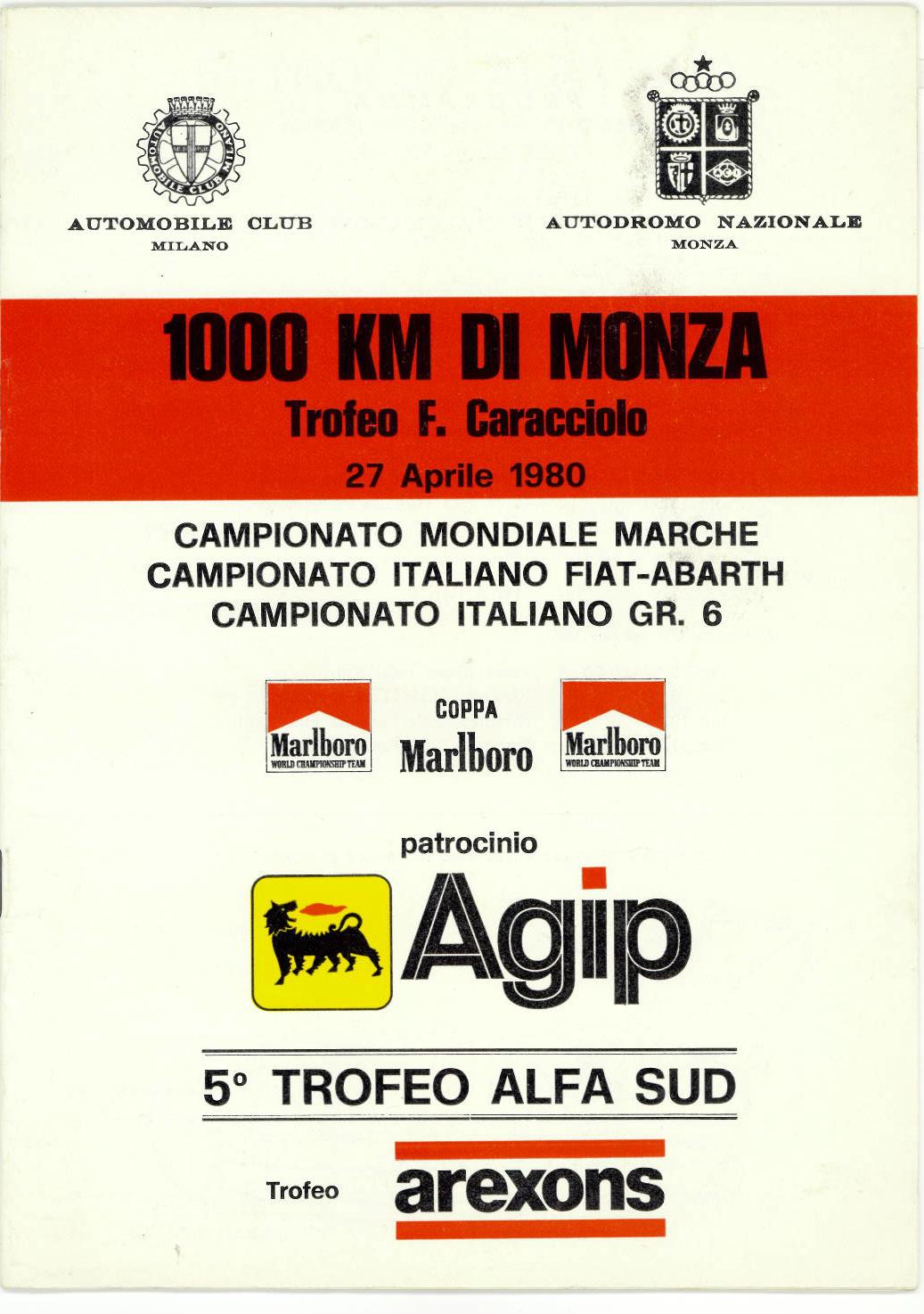
The silver lining to that particular cloud of my IT career was that I got to go to Monza; twice in fact: the first time to see the 4-hour, European Touring Car Championship race in March, and the second to see the 1000km World Championship of Makes race in April. Rather like the Motor Speedway at Indianapolis, Monza is a place that is defined by its race circuit. Its surroundings are the very stuff of which motor racing legend is made.

On both occasions, I made my way there on public transport. It was a relatively straightforward trip: from my digs in Lugano, the train went directly to Milan, crossing the Italian border at Chiasso. From Milan, a provincial train service then took me to Monza, and then there was just the matter of a three mile walk from the station to the famous Royal Park, in whose grounds the Autodromo Nazionale is to be found.

As a motor sporting venue, I can only describe Monza as magnificent. Neither of the events I went to was particularly well-attended, but the atmosphere was still tremendous. The huge grandstand overlooking the startline, the famous electronic scoreboard, the columns guarding the entrance to the paddock; they all contributed to an almost religious feeling. Here was a place that was filled with fervour at the Italian Grand Prix every year, and the echoes of the tifosi were ever-present.

For the Trofeo Mario Angiolini, as the ETCC race was called, on March 23rd, 1980, I left Lugano, according to my diary entry, at 6am. I didn’t actually record the time that I arrived at the circuit, but I described the journey back home again as a “pain – arrived just before midnight”. I recall Italian transport services on a Sunday evening being just as flaky as in the UK.


It was a rather grey and dreary day - as the photos suggest, but brightened up by the presence of a very purposeful looking Mercedes 450 SLC driven by Jörg Denzel and Clemens Schickentanz. The competition was similarly German, in the shape of various BMW 635 CSis. Although the Merc led early on, it turned out that the BMWs were able to spend less time in the pits, and the race was won by the green 635 CSI driven by Umberto Grano, Heribert Werginz and Harald Neger.


Much more memorable was the World Championship of Makes race on April 27th. My diary records that I was on the 05:09 train out of Lugano – I must have got up before 4:30am; boy, I was keen! – and I was at the track in time to see the Alfasud support race that started at 9.30am.

There was a second support race, for Formula Fiat Abarth, which featured folk such as Paulo Barilla and Roberto Ravaglia on the entry list, but the star of the event was a certain Emanuele Pirro, who won the race easily.

For the main race, the entry was good – there were two works Beta Montecarlos from Lancia (being driven by Riccardo Patrese / Walter Röhrl and Eddie Cheever / Piercarlo Ghinzani), along with a third car entered by the Jolly Club. As a Brit abroad, though, the main interest was the British Racing Green De Cadenet-DFV, which the charismatic Alain de Cadenet was sharing with Desiré Wilson. The rest of the Group 6 (aka prototype) cars were, to be blunt, a fairly motley assortment of Osellas, of varying engine capacities.

The main battle of the race was between the de Cadenet and the Sportwagen Porsche 935T, particularly when it was in the hands of Pescarolo. Towards the end of the six hours, though - and it was a six hour duration event, despite being billed as the "Monza 1000kms" - it began to rain, and the big Porsche looked a bit of a handful through the Ascari chicane, where I was standing at that point.

It went into the pits for rain tyres, but the de Cadenet kept going, and ended up the winner of the race by a mere 10 seconds.

They were both great events, and I remember both very fondly. I never got to see a Grand Prix in Italy, but still there were fans climbing onto the advertising hoardings to get a better view, and quite a few, I reckon, coming in through holes in the perimeter fence.

For the police, it was also a grand day out; they would happily point their guns at the fans in the trees, telling them to come down, before sharing a joke with the same fans, who would climb back up again as soon as the cops moved off to another part of the circuit.

I even managed to climb the old banking, covered in moss, for a view of the cars heading down the start-finish straight. Great memories!


Tuesday, 19 March 2013

Twelve Hours of Sebring

Subscribers to DailySportsCar.com will have been able to read, earlier this week, my analysis of Audi’s lap times at the Sebring Twelve Hours. As usual, the team will be staying on at Sebring for a further three days' testing – a tremendously useful way to gather information ahead of what promises to be a closely fought season for the World Endurance Championship.

Races these days tend to create a huge amount of data. Having not been at Sebring, I have no particular access to anything private, but there is still a huge amount of information out there, and for teams that gather telemetry information, the trick is not in gathering the information, but in working out how to use it to draw sensible conclusions.

The trouble is that the data never tells the whole story. There are always other parameters; other factors, that influence what is going on, which it is often extremely difficult to get to the bottom of. Things like engine mappings, tyres, driver technique and so on, can have a massive effect on a car’s lap times (or even sector times), and from the outside you can end up tying yourself in a knot, trying to get to the bottom of it all.

With that in mind, there are some observations about the individual driver performances in the Audi Sport Team Joest cars that time did not permit me to investigate in the dailysportscar article, that I thought were worth sharing. As always, I would welcome your comments.

In the winning Audi, number 1, Oliver Jarvis’s fastest lap time was almost 1.9 seconds slower than Benoît Tréluyer’s fastest lap in the same car. The best that Marcel Fässler could manage, having set pole position, was to lap within a second of the flying Frenchman, but he was still 0.8 seconds quicker than Olly.

Taking the average of the fastest 10 laps of each driver shows a similar pattern:
Tréluyer - 1m 45.544s
Fässler - 1m 46.724s
Jarvis - 1m 47.643s

And the average of the fastest 50 laps of each driver is no different either:
Tréluyer - 1m 46.633s
Fässler - 1m 47.857s
Jarvis - 1m 48.852s

Looking at the same information for the number 2 Audi, gives:
Average of fastest 10 laps
Kristensen - 1m 45.681s
McNish - 1m 46.324s
Di Grassi - 1m 47.176s

Average of fastest 50 laps
Kristensen - 1m 46.951s
McNish - 1m 47.391s
Di Grassi - 1m 48.645s

In each case, the order matches the driving order in the car, so the fastest driver started the car, the slowest drove third. Both Audis also copied each other in terms of driving stints, so let’s analyse each stint:

Audi #1
Stint No. Driver Laps Best lap Average of best 10 laps Caution laps
1 Tréluyer 44 1m 45.061s 1m 45.758s None
2 Fässler 49 1m 46.111s 1m 46.937s 5
3 Jarvis 48 1m 46.952s 1m 47.682s 4
4 Tréluyer 78 1m 45.211s 1m 46.098s 5
5 Fässler 65 1m 46.216s 1m 47.183s 6
6 Jarvis 46 1m 47.699s 1m 48.609s None
7 Tréluyer 34 1m 47.121s 1m 48.227s None

Audi #2
Stint No. Driver Laps Best lap Average of best 10 laps Caution laps
1 Kristensen 43 1m 44.870s 1m 45.704s None
2 McNish 62 1m 45.572s 1m 46.399s 5
3 di Grassi 59 1m 46.537s 1m 47.176s 4
4 Kristensen 49 1m 45.956s 1m 46.798s 5
5 McNish 69 1m 46.227s 1m 47.390s 6
6 di Grassi 44 1m 48.356s 1m 49.146s None
7 Kristensen 38 1m 48.024s 1m 48.454s None


All this seems to suggest quite strongly that both di Grassi and Jarvis were significantly slower than their team-mates, which, based on their performances in largely similar cars last year, is surprising to say the least. Maybe it is purely that they were less familiar with both the team and the track?

Also, while I would expect Tréluyer to be quicker than Fässler, I am surprised that Tom Kristensen managed consistently to lap quicker than Allan McNish.

Like I said before, the data doesn’t tell you everything. But if there is an explanation for this, then I’d like to hear it.


Friday, 15 March 2013

Memories of the Classic Tracks

I mentioned a while ago that I have visited more than forty different motor sporting venues over the years, and as time goes by, I recall my visits to some of those with increasing affection. I don’t fully go for the expression ‘bucket list’ – it being one that was only invented in the last ten years – but I do understand that people have such things and I count myself lucky that I have visited a good number of places that appear on other people’s bucket lists.

Excluding Le Mans, which, although it still has magic, is now so familiar that I can no longer treat it with such romanticism, the three circuits that sit in my memory with a very special feeling are Indianapolis, Monaco and Monza. Over the next few weeks, I thought I would share my impressions of visiting these icons of motor sport – surely places that all fans should try and get to before they shuffle off this mortal coil.

First, Indianapolis, which I have visited only once, for the 500 in 1991. A work colleague had been given complimentary tickets for two seats in the grandstand at Turn 4, and he happily let me have them, although I can’t remember now whether any money changed hands.

It was a very brief visit – I arrived at the Motor Speedway early on the Sunday morning of the race, but could not make time to visit the museum – although I did walk past its entrance on my way to my seat, ready for what was scheduled to be an 11:00am start for the 75th running of the 500 mile race. To call the place a stadium is not quite right – but that word at least it conveys the image of many tiers of seats surrounding the amphitheatre of the track. Try to imagine Epsom Downs on Derby day, with grandstands surrounding the whole thing, and you get an idea of the scale of the place. Maybe that’s a slight exaggeration, but there is something a bit special about being part of a crowd of 400,000 – the largest single-day attendance for a sporting event in the world.

The weather in Indiana in late May is usually good, but there are no guarantees, and there was light rain on the morning of the race, which resulted in a doubt about when the start would be. Announcers kept us informed that no further rain was expected, and that the track should dry out quickly enough for the race to go ahead. In true American style, there was entertainment, but that did not involve any support races: it was mainly marching bands and celebrities.

Under each seat in our section of the grandstand was a coloured board (mine was plain red), somewhat larger than an A4 piece of paper and during the rather long wait for anything to happen on the track, we were instructed how to hold it above our heads by a sort of cheerleader chappie at the front. General Norman Schwarzkopf (Stormin’ Norman, the American hero of the Gulf War) was there, in the role of Grand Marshal, and was due to do a lap of the track in a convertible. As the General came around the signal was given, and we all raised our boards. The General raised his right hand and returned us a salute – those more experienced in such palaver than I knew about it all along, but I hadn’t realised we were portraying a giant-sized stars and stripes flag for him. Very, erm… patriotic, but very memorable too.

Schwarzkopf wasn’t the only celebrity there – so was the then FISA President Jean-Marie Balestre, invited by Tony George, and setting speculative tongues wagging in the process about where Indycar racing might be headed. Vice-president Dan Quayle, who had served as Grand Marshal the previous year, was also there; and Carroll Shelby was driving the pace car. Make no mistake; the Indy 500 was one of the most significant events in the USA sporting calendar. It is (was) big; very big, and lived up to its self-proclaimed slogan “The Greatest Spectacle in Racing”.

Because of the damp track, the start of the race was delayed by nearly an hour, but when it finally got under way it was impressive stuff. The initial sensation was the speed. At turn four, the cars were coming past in excess of 220 mph – at first I couldn’t turn my head fast enough to see the numbers on the side of the cars, which made keeping the lap chart rather tricky.

Contemporaneous Notes
It was all too long ago for me to remember the detail of the race itself. The most vivid memory: the high speed trains of cars that came past, sometimes inches apart. The thought somehow that the whole procedure was an elaborate dance with the devil – disaster was never far away. Several big accidents happened just out of view at Turn 1. From pole position, Rick Mears in the Marlboro-sponsored Penske achieved his fourth victory at Indy. It was a popular win, and by a strange quirk of fate, Chris, his wife, happened to be on the same bus as me back to the airport from the Motor Speedway. Why she wasn’t joining her husband in the celebrations, I don’t know, nor have I ever found out.

The following day was the Memorial Day bank holiday, and such was my energy and passion in those days, that having got back home to Bergen County, New Jersey, on Sunday night, I drove up to Lime Rock, for the IMSA GTP race the following morning. I’ve often wondered how many others did the same ‘double-header’!

At the time, I was going through a ‘no camera’ phase in my life, so I don't have any photos of my own from the event, but I bought a programme, of course, which featured a rather arty painting depicting the very first Indianapolis 500 in 1921 for the cover.

And inside the programme was an extremely good fold-out section, showing the grid positions - an early version of an ‘Andy Blackmore Spotter Guide’?


Tuesday, 26 February 2013

Revolution in the Air?


A lot has been written in recent months about the state of sportscar racing and the direction that it is taking. What with the GrandAm merger with the ALMS (or was it a takeover?) and new ACO regulations in the pipeline, we are indeed going through a time of change. Change always happens, though, so that’s nothing new; what makes the current situation different is that the changes ahead have an air of revolution about them.

The United States of America is not alone in sometimes taking itself too seriously. Many ‘important’ countries occasionally fall into the trap of believing that the world ends at its own borders. There is more than a hint of truth in the old headline “Fog in Channel – continent cut off”.

But the USA is bigger, more important, and more easily ensnared by the trap. Sports like baseball are particularly “American”. Basketball and ice hockey, which are widely played across the world (and more popular even than cricket or rugby?) have such a strong presence in the States that the Americans can lay claim to the phrase “World Class”.

But I do find myself smiling inwardly to myself when I hear Americans talking of the importance of American-based motor racing. While America has NASCAR and IndyCar, these are clearly USA-centric and for me fall into the category of baseball and American football. When talk turns to sportscars, the US finds the stage already occupied. From some of what you hear, you would be forgiven for thinking that the whole future of endurance sportscar racing hinges on the choices made by those who are currently evaluating the regulations for the unified American series in 2014.

The trouble is this. In the USA, NASCAR and IndyCar racing have no overlap with other forms of motorsport elsewhere in the world, whereas sports-prototype and GT racing does. What the merger of Grand-Am and ALMS has done is to remove Grand-Am from being a national race series (if you know UK club racing – think Legends) and to place upon its successor the opportunity to define a class for international prototypes. This is a huge opportunity and how it is dealt with is fundamental to the future direction of sportscar racing worldwide.

To my way of thinking, the unified American series will go one of two ways – either they’ll get it wrong and it will disappear; to fall into sub-categories of the European classes, or they’ll hit the jackpot, and create something sufficiently attractive to both manufacturers and privateers to which spectators, journalists and media will come in numbers.

On the international stage, sports-prototypes are getting themselves into a bit of a knot. There’s a good case that the knot exists already. The ACO’s LMP1 category is (unintentionally) excluding privateers as the manufacturers raise the bar to higher and higher levels. LMP2 is becoming a headline category, but with no chance of achieving outright wins in the World Endurance Championship.

What is needed is a prototype category in which manufacturers can showcase their technology, and privateers can compete against them, by being fast, efficient and – yes, by exploiting loopholes in the regulations.

So, then, just imagine you have a blank sheet of paper, no particular political allegiance one way or the other, and no axe to grind; and consider this: Prototype Pro and Prototype Am. Or perhaps better expressed as “Prototype Manufacturer” and “Prototype Privateer”. Hopefully the distinction is clear. If you build the car, then you’re a manufacturer. If you buy it, you’re a privateer. If a manufacturer gives you a car, (look out, Nick Wirth), then sorry, but that still counts as a manufacturer. Maybe the distinction needs to be made clearer still, by saying that if you’re a manufacturer entrant, then your car has to be a closed prototype; if you’re a manufacturer selling to privateers, then your car has to be open-topped.

Do you see where I’m going here? If you’re a manufacturer and you want to go prototype racing, then you have to build a specification (closed) chassis. Not a Daytona Prototype in the current sense, but a World Prototype, sanctioned by the FIA. Think of the potential – Audi, Peugeot, Toyota, GM, BMW, Ford. It’s too late now to do it for 2014, but it could be the basis for 2016 regulations. And there’s no reason why it couldn’t be driven by energy consumption, to take the 2014 regulations further in that direction.

The existing LMP2 category is close to providing what the privateers want – the only thing that it doesn’t do is to enable them to compete for outright victories. This is where the clear definition between closed and open cars comes in – the regulations can allow for more horsepower or ‘higher energy consumption’, if you prefer to phrase it that way, for the open, privateer prototypes.

In the field of GT racing, there is in some senses an embarrassment of riches: there is currently a very good level of interest from manufacturers and drivers alike, but critics will point at the confusion of classes. With the possibility to race your GT car for 24 hours at Dubai, Daytona, the Nürburgring, Le Mans and Spa-Francorchamps, it seems somewhat bizarre that technical regulations are different at each event. Surely, if unification of the Prototype classes is being discussed, unification of GT regulations must happen too?

The biggest decision faced by the rule-makers in GT is to establish whether it is a raw meritocracy, or whether the objective is to encourage close racing. Manufacturers’ figures show that the performance of a Ferrari 458 Italia is better than an Aston Martin Vantage, but it’s also £40,000 more expensive. If you’re spending that kind of money on a car, there’s more to your purchasing decision that merely 0-60 times. And whether it wins or comes fourth in some motor race is not such a significant factor (in my book) as the fact that it is in the race. Prestige, both for the manufacturer and the event, comes from participation.

Looking back, 1999 was the high point in recent years at Le Mans for manufacturer participation, with eighteen works cars from six different manufacturers (BMW, Audi, Nissan, Toyota, Chrysler and Mercedes-Benz). That should really be twenty-three, including the cars from Riley & Scott, Courage and Panoz, since they were also entered by the teams that built them. There was no magic formula that attracted manufacturers in such large numbers then, and there was no performance balancing; rather it was quite simply that everyone wanted to be in the race. Clearly, not every manufacturer entry was in with the same chance of winning; the objective of some was just to finish. But with every manufacturer entry came added prestige and that in turn provided a sense of importance to the race, and to the World Championship series of which Le Mans was just a part.

The same is true today.

Tuesday, 12 February 2013

Australia for the Bathurst 12 Hours

It was a huge privilege to be able to attend the Bathurst 12 hours. It was an adventure to visit Australia, as I had never been before, but it was Mount Panorama itself that made the most impression.

Arriving in the middle of the Australian summer after a journey of more than 30 hours from freezing temperatures at home, was bound to jolt the system more than somewhat, and I have to admit that my anticipation was high, having been told by many people of the treat that I had in store, being able to visit one of those iconic circuits that I had seen on TV so many times.


The reality, to my surprise, exceeded the expectations. Bathurst is a very special place, and the Mount Panorama circuit is a very special race track. It is of course defined by its ‘Mountain Section’ – a roller-coaster ride up and over the ‘Mountain’ that gives the circuit its name. It may not be a mountain in the alpine sense of the word, but is certainly big enough to be what the Scots call a ‘Ben’, rising up to a height of 862m above sea level, and towering 174m above the pit and paddock complex below. The views from the top are simply stunning: on a clear day, it feels like you can see the whole of Australia (you can tell that I still haven’t quite taken on board the enormity of the continent, can’t you?). The layout of the circuit is classic; the corner names familiar – Skyline, the Dipper, the Elbow; unmistakable, if often corrupted by the names of a corporate sponsor.


I took a walk during one of the practice sessions, to get a feeling at first-hand what it is that makes Bathurst a mecca for racing fans. I started at Reid Park, already part way up the elevation, a series of fast corners where the need for delicate positioning of the car must be balanced against the commitment to use raw horsepower to get up the hill. A sweeping series of multi-apex left-handers brings you onto Skyline, and here I was for the first time surprised. Here you can marvel at the vista spread out before you; the paddock in the foreground, and the mountains in the distance; capped, if you’re lucky, by acres of blue skies. The circuit straightens up, cars travelling from left to right, and under a bridge – but drivers seem tentative, unwilling to commit to full-on acceleration. It’s early in the session, though, so I press on round the circuit… the esses are next. And here is the explanation. Driving over the top of Skyline is a bit like jumping off a cliff. Except that rather than free falling, you have to negotiate the right-left-right sequence of corners going downhill – think Craner Curves, but three times as tight and five times as steep!


Then it’s the Dipper – more of the same, but even less visibility of the track ahead – if you’re a skier, think of a steep mogul field with a blindfold on to get an idea. The spectator enclosure is not large, by any means, but affords a simply fantastic sight of cars on the limits of adhesion, threading the needle. The contours are packed, the slopes sheer. You can look down on the top of a car at one point, scramble down a slope, and suddenly the cars appear above you as they exit, trying to stay off the kerb, which will upset the balance before the next turn. Which is The Elbow, virtually a hairpin, and the final corner before another iconic name in motor sport - the Conrod Straight.


Conrod Straight is aptly named. Unlike some ‘straights’ in motor sport, Conrod Straight is arrow-like for two kilometres. Downhill but undulating, it finally arrives at the ‘Chase’, a fast right handed swerve into the newly built-chicane that leads back to the start finish straight.

Anyone who has visited a famous place will know the feeling: the recognition that the images hitting your retinas are images that you’ve seen before, in pictures from books, magazines or TV. It happened to me the first time I went to Le Mans. Seeing the Dunlop Bridge, knowing that cars would be going light before heading downhill towards the esses, where they would swing left, then back to the right and slightly uphill. It was all familiar and yet simultaneously wonderful.

The same thing happened as we came to Bathurst. First had been the sight of the words ‘Mount Panorama’ painted on the side of the hill, but then as I turned the rental car through the gates and into the circuit came the recognition that we were on the startline, driving over the grid markings, heading towards Turn 1 – Hell’s Corner! The pits were on our left, and countless replays of touring car races from the eighties flooded my mind.

A few minutes later, and I was lost in a camp site, trying to find my way into the paddock. “Can I help you, mate?” came a voice from a man dressed in a singlet, sounding a bit as if he meant: “Get off my land!” I explained my predicament and his swarthy features cracked into a smile. “You need to turn round, head back up there, turn left up the hill, then go back down again!” he said (I think).

Finally
, we (Shea Adam and I) found our way to the media centre, and found an even more hearty welcome. Without question, they do things (motorsport-wise) differently in Australia (timing to four decimal places for example). Unlike in the USA though, they don’t seem to justify – nor defend – such differences; simply put, it is merely different, live with it.

As a race, it worked extremely well. I could go off on a rant about safety cars, but that would be churlish. The 12-hour format, all in daylight, was great, the entry was good, and the most deserving, if not the quickest, team won. As a circuit, it is a bit like a cross between Nürburgring and Cadwell Park. But somehow that over-simplifies the matter, as it fails to take account of the ‘Australian-ness’ of the place. Despite being more famous for its Grand Prix circuits at Adelaide and Melbourne, something about Bathurst encapsulates Australian Motor Racing. They called the Bathurst 1000 “The Great Race” for a reason.

If you get the chance to go, then take it, you won’t be disappointed. The organisers said that there were 22,000 there this year, and that is likely to continue growing. I hope, I really, really do hope, that I get the chance to go again – and it’s the sort of place that my family would enjoy as well.


Thursday, 17 January 2013

A trip into the desert

Back from Dubai, then, where I thoroughly enjoyed covering the Dunlop-sponsored 24 hour race as part of the RadioLeMans.com crew. Having now also completed the analysis for dailysportscar.com, where you can read about average lap times and the like, the time has come for me to update my blog.

The trip began at 9:30am on Tuesday morning - fellow commentator Bruce Jones kindly gave me a lift to Heathrow (in his VW Golf). His excuse that he lived in the country surely didn't sufficiently explain how disgracefully dirty the car was, but as a means of transport it sufficed, and we parked in the long term parking and headed off to terminal 5 to check in for BA flight 107. Once there, we met up with Nick Daman and before long Jim Roller showed up too. Jim had landed that morning from the USA and his first port of call was somewhere to get changed, as it seemed someone had emptied a cup of tea over him on his transatlantic crossing, and in addition to the scald, he also lost the use of a good shirt.

The flight, six and a half hours, was reasonably pleasant although it was gone midnight by the time we had cleared immigration and customs in Dubai, met up with John Hindhaugh and set off through the dark streets to find our hotel. Don't ask me how, but John had managed to persuade Porsche Middle East to lend him a Panamera +4S: luckily Nick managed to keep up in the hired Toyota Previa, and we eventually rolled into the underground car park of the Holiday Inn Express, to get to bed sometime around 2am local time.

Up at 7:30am on Wednesday morning, and off to the track: John and Eve leading the way in the Porsche; Jim, Bruce and I hanging on as Nick weaved through the traffic in pursuit. First stop after the media centre was a meeting with the TV company that was providing the pictures for the event, who needed to know our requirements, just as we needed to know theirs. Then after a quick lunch, it was up to the commentary box, from where we were to cover the Optional Private Test session, which would run from 1pm until 5pm.

Obviously, given its location overlooking the Arabian Gulf, Dubai is pretty much a desert location. I am told that, a hundred years ago, it was merely a creek, where the sea made an inroad into the peninsula on which the emirate now sits, and I can well believe it. The last fifty years have seen a frenzy of building projects, many of which are still underway, and many others of which seem to have been simply abandoned, incomplete.


The track sits in the region known as Motor City, a zone intended to promote the car industry. It was originally intended to attract an F1 Grand Prix, but it seems that the money ran out before all the auxiliary buildings could be completed. Once inside the confines of the track, though, this becomes less obvious, as you are distracted by the paraphernalia of all that a modern international motor race entails. The organisation of the event is first-class; you are made to feel extraordinarily welcome wherever you go and even though there are no support races, you still feel quite busy the whole time.


The commentary booth is ideally positioned on the outside of the circuit, providing a great view of almost all the circuit. It is only the contours of the place that cause cars to disappear out of view at various points. A good view is also afforded of the pits and podium, and a good pair of binoculars is required to see the detail of the further reaches of the place. Of course the drawback of being on the outside of the circuit is that it is a bit of a trek back to the paddock, media centre or catering facilities.

The commentary box itself is well-appointed, with a really effective air-conditioning system, requiring the use of jumper and fleece overnight as the thermostat setting on the wall was beyond any of our abilities to adjust!


On Wednesday evening, the organisers laid on a "Welcome Barbecue Party", which provided enough burgers, kebabs and sausages to keep more than 500 guests happy. There was even a bouncy castle.


On Thursday we concentrated on practice and qualifying - a full day in which there were two free practice sessions, three qualification sessions and night qualifying, running to 8pm. Catering for the event is provided by Marriott Courtyard, which does a fine job, supplying a wide variety of mainly western food for team members, media and race officials. Although this is a great way to keep from getting hungry, it does mean that I am still slightly curious (and completely ignorant) of the local cuisine.


Friday morning - raceday - dawned cloudy, with a bit of a chill in the air. Not that it was catch-your-breath cold, just that you really needed at least a jacket on. Warm-up was at 10:30am, but we still had an early start as we were checking out of the hotel that morning, which meant packing everything into the suitcase and into the back of the Previa. After the warm-up, it was time for another visit to the timekeepers to ensure that I understood how they would be keeping us updated - and keep us updated they certainly did, so if you're reading this, thanks very much!


I found the early stages of the race hard-going, I must admit. Repeated use of the Code-60, and the fall down the field in the early stages of obvious front-runners, meant that there was more to keep track of than I could manage. As darkness fell, and the race settled into its rhythm, though, I was happy enough - and we ended up with a jolly good race, one which held my attention to the end.

But then I am an unashamed fan of 24 hour racing - Dubai was the 53rd 24 hour race I've been at - and I find that the more I go to, the faster they seem to go by. Maybe it's a sign of my age!

Anyway, race over, we uninstalled all our equipment from the booth, packed it all into the bags, and set off for the airport. Nick was flying out a bit earlier, as he was going to join his girlfriend in Goa, while the rest of us had a rather drowsy wait until our flight departed at 2:55am local time. Once in the air, it was time for some serious sleeping, as the BA 747 took us back to temperatures of 2 degrees Celsius, landing at Heathrow shortly after 06:30am. Once again, I was grateful to Bruce Jones for providing me with a lift home, and the family just waking up for a quiet Sunday at home.

A great trip, a super race and some splendid people along the way. Thanks to you all. And an especially big thank-you to my wife, for allowing me the space in our calendar to make the journey. Next stop, the Bathurst 12 hours!